Autofluorescence Imaging

Inverted widefield fluorescence microscope with an image splitter for dual picture imaging on a single camera. Currently set up for simultaneous imaging of NADH and FAD. Excitation light provided by a white light LED (X-Cite) through a 357/44 nm filter. Image splitter contains a 496 nm dichroic and 415/106 nm and 560/94 nm emission filters. …
Imaging Cell Metabolism

Reduced nicotinamide adenine dinucleotide (NADH) and flavin adenine dinucleotide (FAD) are two co-enzymes that are used in metabolic reactions. These molecules, NADH and FAD, are fluorescent which enables label-free imaging these molecules on fluorescence microscopes. The fluorescence intensity and lifetime of NADH and FAD provide information about these molecules and their use in cells. We …

Laser-tissue Interactions

Short pulses (ms to ms) of infrared light (1400-2100 nm) can excite action potentials in neurons; however, the mechanism driving this phenomenon is unknown. We are currently testing the hypothesis that infrared light alters the metabolic or redox balance of a cell. In support of our hypothesis, we have developed a model of infrared light …

Immune Cell Phenotyping

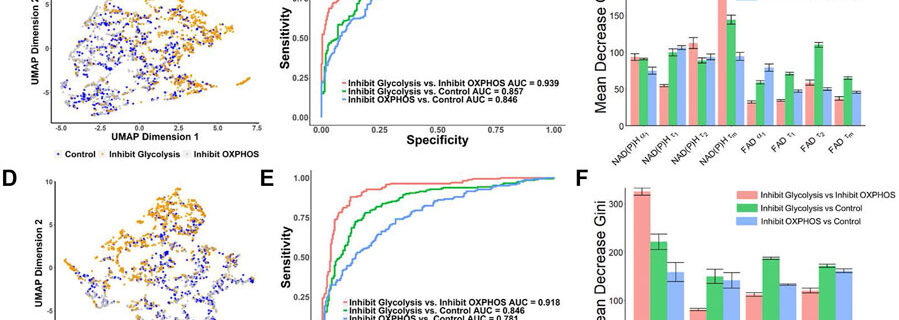
Recent Publications: Currently, the activation of immune cells is assessed by label-based methods including flow cytometry and immunohistochemistry.  Activated immune cells require high rates of glycolysis to maintain immune activities.  Therefore, we are using fluorescence lifetime imaging of NAD(P)H and FAD which reports cellular metabolic information, to evaluate immune cell function.  We have shown that the combination of machine …

QC/QA of Biomanufactured Cells

Cell-based therapies harness functional cells or tissues to mediate healing and treat disease. These cells or cell products must be cultured and manufactured in a manner that maintains sterility and cell viability and function. Currently, methods that can assess the viability and function of cells are destructive and/or reply on contrast agents that are not compatible …

Imaging Drug Response

Tumor drug resistance due to heterogeneous cell populations remains a significant challenge for cancer treatment.  Optical imaging of the fluorescence lifetimes of NADH and FAD, coenzymes of metabolism, can be used to track anti-cancer drug response in a label-free, non-contact manner. This imaging technique, “optical metabolic imaging,” can be performed on cancer cells and tumors …

Graduate Research Symposium 2023

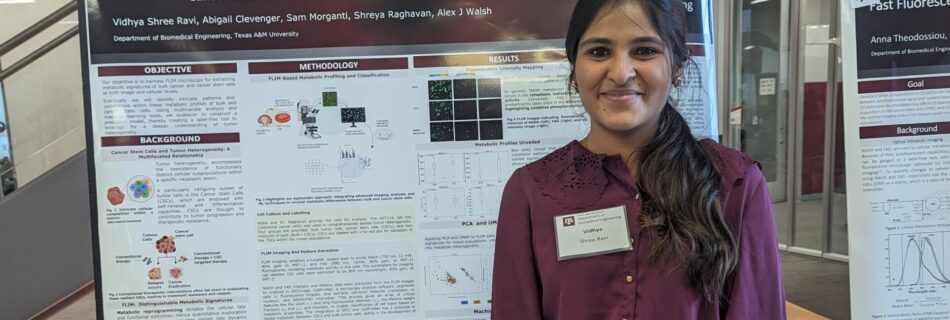
We had fun at the Biomedical Engineering Department’s Graduate Research Symposium. 100% of the QOIL graduate students and post-doc trainees participated as attendees, presenters, and poster judges! Presentations:(Poster) Fast Fluorescence Imaging of Metabolic Coenzymes, Anna Theodossiou, Jocelyn Martinez, and Alex J. Walsh(Poster) Unveiling the Metabolic Diversity in Cancer: Quantifying Cancer Stem Cells and Bulk Cancer …

Carley Conover REU Presentation

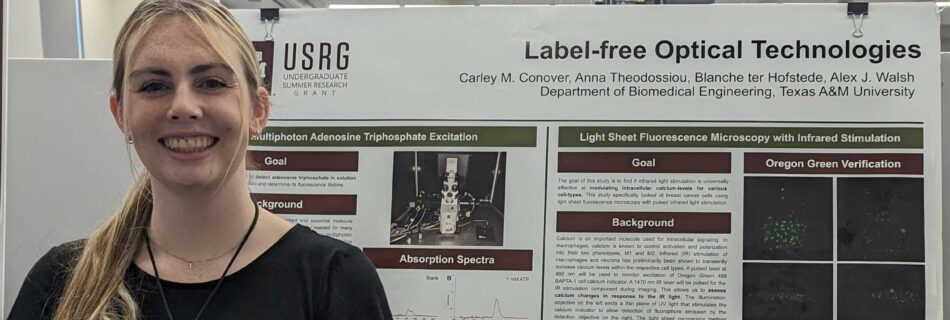
REU student, Carley Conover, gave an exciting poster presentation on her summer research at the Engineering REU Poster Session!

Paper published on FLIM analysis methods for machine learning

Congratulations to Blanche ter Hofstede and Linghao Hu on the publication of their paper, “Comparison of phasor analysis and biexponential decay curve fitting of autofluorescence lifetime imaging data for machine learning prediction of cellular phenotypes” in Frontiers in Bioinformatics! In this paper, we compared two different fluorescence lifetime imaging analysis techniques, phasor analysis and exponential …

Tissue Culture

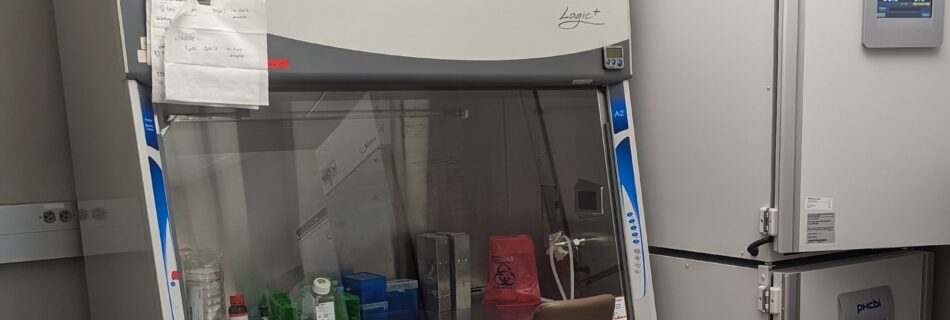
Fully equipped tissue culture facility adjacent to the microscopy rooms.